How to Read Health Conditions on the Face through Chinese Face Reading
By Mieke Fraussen
In general, a great deal can be said about a person’s overall health simply by looking at their face.
Everyone can read faces. Since the dawn of humanity, the face has played an essential role in identifying people and has served as a key element of emotional communication. You recognise your mother the moment she enters the room, and when she is angry, you can clearly see it on her face.
The face also shows signs of health problems or even diseases of the internal organs.
In Western medicine, direct observation of the face is part of medical diagnosis. A pale complexion may indicate anaemia, a yellowish tint can point to liver disease, and blue lips may suggest heart or lung conditions. The face also reveals a great deal about a person’s mental and emotional wellbeing. Fatigue and lack of sleep, for example, are clearly visible through dark circles or puffiness under the eyes.
In Eastern medicine, observing the face (face reading) is also an integral part of diagnosis in Traditional Chinese Medicine. Traditional Chinese Medicine practitioners observe the face, examine the tongue, listen and smell, ask about symptoms, and feel the pulse before forming a diagnosis.
History of Chinese Face Reading
As early as ancient China, face reading was passed down orally. People learned how to read imperfections, illness, and personality from the face.
 Face reading originated nearly 3,000 years ago in China. Originally, this medical art was practiced by Taoist monks. At that time, healers were not allowed to touch women, which forced them to develop alternative diagnostic techniques, long before X-rays and laboratory tests existed. They carefully observed every facial feature and marking to understand the emotional and physical state of the body.
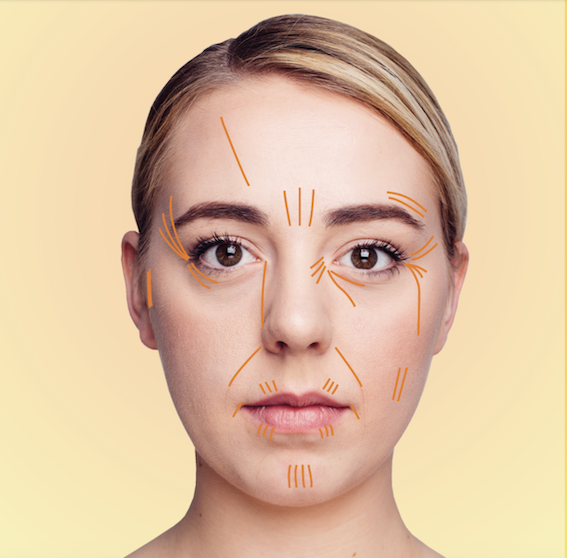
What makes face reading so valuable is that facial symptoms often appear long before a disease manifests. These signs act as early warnings which, when addressed through lifestyle adjustments, can protect long-term health. Chinese face reading provides the knowledge to recognise these signals. Every marking on the face has meaning. Every spot, line, scar, discolouration, mole, indentation, swelling, fold, or crease reveals information about physical and emotional health.
Methodology
Before forming a TCM diagnosis, it is essential to first observe the shen, the overall vitality and presence. This is seen through skin colour and the brightness of the eyes.
Next, each part of the face is examined. Changes in shape, size, colour, and markings are interpreted in relation to the five elements. This information is then compared with other diagnostic methods, such as tongue observation and pulse reading. Only then are symptoms treated.
Facial Colours
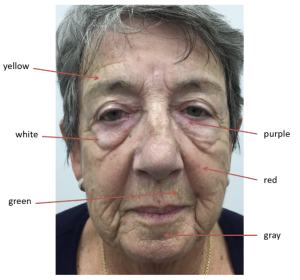
Changes in facial colour (shen) are believed to reflect pathological changes in the body.
Chinese Medicine categorises facial colours into five groups: green, yellow, red, white, and black. However, the relationship between colours and the five elements must be interpreted carefully and never applied rigidly. A generally yellow complexion may indicate an Earth imbalance, but it can also point to dampness.
The most commonly observed facial colours are grey, bluish-purple, red, and white. Trained Chinese Medicine practitioners can also quickly recognise yellow and green tones. Here’s what these colours can indicate:
- White – A pale or white complexion always indicates some form of depletion or deficiency.
- Red – suggests heat, either in the face or elsewhere in the body, often interpreted as inflammation.
- Green – A greenish hue is rare and usually points to toxicity or imbalance in the liver or gallbladder.
- Yellow – indicates fluid retention, dampness, or phlegm. Yellowing of the face or sclera may also indicate jaundice.
- Blue/Purple – These colours indicate stagnation, similar to a bruise, suggesting blocked qi and blood flow.
- Grey – A grey complexion also points to stagnation and may indicate serious illness.
If you notice an acute colour change in specific facial zones – such as green, yellow, or grey – or a combination of red, purple, black, and white, it is important to consult a Western medical doctor to rule out serious conditions.
Organ Zones
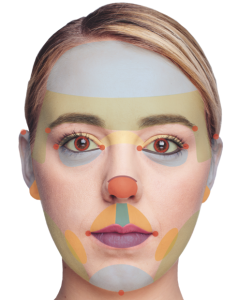
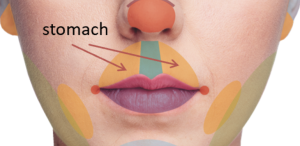 The location of facial markings is equally important. According to Chinese face reading, different facial areas correspond to specific organ systems. The cheeks relate to the lungs (metal), the eyebrows to the liver (wood), and the area above the lips to the stomach (earth).
Location can also help predict the age at which certain issues may arise by using the 100-year face map. The size and darkness of a marking indicate severity, larger and darker marks suggest more serious conditions.
Putting it Together
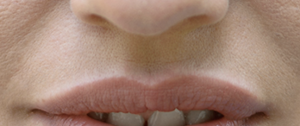 What do these colours mean when they appear in a specific organ zone? Let’s use the stomach zone as an example.
- A white discolouration in the stomach zone indicates cold in the stomach (qi, yang, or blood deficiency), often caused by excessive consumption of cold foods. Adding warmth to the diet is essential.
- Redness in the stomach zone suggests stomach heat (stomach fire).
- A yellow colour indicates dampness due to poor fluid metabolism.
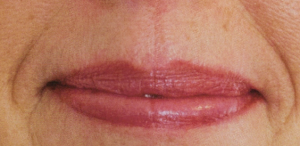 A proper Chinese diagnosis always considers markings across the entire face.
For example, in cases of stomach qi deficiency, the nose bridge, another stomach/spleen zone, is also examined. Other organ zones are read to assess symptom progression. Findings are confirmed through tongue diagnosis and a full medical assessment.
Symptoms may have physical or emotional origins, and this can only be clarified by asking the person directly.
Emotional Mapping
Facial markings can also result from unresolved emotional processing.
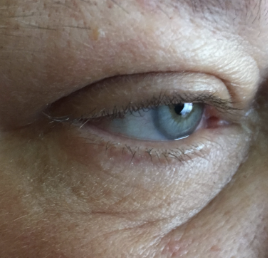 Again, using the stomach zone as an example: a white discolouration may reflect emotional emptiness caused by grief. Grief often suppresses appetite and disrupts sleep, leading to depletion of stomach qi. The stomach zone appears pale and sunken, and this whiteness may eventually shift to redness.
Others respond to emotional distress by overeating. In such cases, swelling and yellow discolouration appear in the stomach zone. The upper eyelids, also related to the stomach and spleen, may swell, often accompanied by general weight gain.
Emotional states can also be observed through markings such as wrinkles. White discolouration in the stomach zone caused by grief often appears alongside hollows, lines, and dark shadows on the cheeks, which belong to the metal element.
Conclusion
Observing the face has always been a vital diagnostic method in Traditional Chinese Medicine. However, this skill is rarely included in Western TCM training due to a lack of qualified teachers. Fortunately, over the past decade, several masters worldwide have begun passing on this long-hidden knowledge.
Over many years, I have studied face reading across different cultures. As an acupuncturist, I connected this knowledge to the Five Elements. I am deeply grateful that several masters crossed my path over the past 30 years.
As a Face Reader, it has always been my dream to share my passion and knowledge of Chinese Face Reading with others, especially by training and coaching new Face Readers.
If this has sparked your curiosity and you want to learn more about these TCM diagnostic skills, and how to apply them in online therapy, why not join our two-day Introduction to Chinese Facial Diagnosis course in June at ICOM in East Grinstead. It’s open to those with knowledge of TCM acupuncture, tui na, qigong, herbalism, nutrition or reflexology.
About Mieke Fraussen
 Mieke Fraussen is now considered one of the leading experts in the field of Chinese Face Reading and facial analysis, following the passing of Lillian Bridges, with whom she trained extensively.
Over 20 years ago, she left a successful career in advertising to delve into human health. After a brief stint as a naturopathic therapist, where she studied Western facial diagnostics, and as a shiatsu therapist, where she gained knowledge of Japanese Face Reading, she encountered traditional Chinese medicine (TCM). She even obtained a nursing diploma to further her understanding in this area.
This marked the beginning of her journey through the five pillars of TCM. At the TCM congress in Rothenburg, she met Lillian Bridges. Lillian’s vision of a person’s talents and potential, visible and understandable simply by looking at the face, inspired Mieke to deepen her knowledge in this form of Face Reading. She travelled the world to study various forms of Chinese Face Reading.
During these travels, she also delved into BaZi and Feng Shui. Thanks to the insights she gained through Face Reading on an emotional and mental level, Mieke delved deeper into this field. She pursued training with western experts such as Dr. Gabor Maté and Bessel van der Kolk where she developed a deeper understanding of the mind’s functioning and the deeper meaning and origins of trauma.
She then integrated this knowledge into her expertise in Face Reading and in Traditional Chinese Medicine (TCM). In addition to her work as an acupuncturist, mental health practitioner, herbalist, nutritionist, and qigong teacher, Mieke also trains others in Face Reading. Her deep knowledge and years of experience make her a respected and sought-after expert in the field. She has helped countless people gain a better understanding of themselves and their health through the insights she offers via Face Reading. Mieke’s dedication to the field and her ability to blend the ancient wisdom of Chinese Face Reading with modern techniques make her a pioneer and an inspiring teacher for many.