Exploring the Gentle Art of Japanese Acupuncture
In the landscape of East Asian Medicine, where Traditional Chinese Medicine (TCM) often dominates the conversation, Japanese acupuncture (Hari 鍼) stands as a refined and deeply distinct tradition. For practitioners trained in the UK, discovering Japanese styles is often a moment of revelation. It represents a shift from the robust stimulation of TCM toward a practice defined by subtlety, palpation, and a less is more philosophy.
While TCM often emphasises achieving a strong De Qi (needle sensation), Japanese acupuncture historically evolved in a different direction. For several centuries in Japan, the profession was largely reserved for the blind. This unique history allowed the tradition to hone an extraordinary level of palpation skills; diagnosis is not merely asked as it is felt. The needles are typically thinner, insertion is shallower (sometimes mere millimetres or even no insertion at all), and the focus is frequently placed on the abdomen (Hara 腹) as the central diagnostic map of the body.
Our CPD Philosophy
At ICOM, our training philosophy, both for our undergraduate students and our postgraduate practitioners, revolves around in-depth transmissions from leading teachers across the globe. We are thrilled to announce our upcoming 2026 Japanese Series: a CPD sequence focused on three distinct pillars of Japanese practice. These courses are designed for everyone from newly qualified practitioners to long-standing clinicians, as well as those looking to deepen prior training in styles like Toyohari.
1. The Art of Moxibustion (Okyu お灸)
In many Western clinics, moxa is often an afterthought. In the Japanese tradition, however, it is an art form equal to acupuncture itself. Japanese moxibustion offers a diverse array of clinical applications far beyond simply warming a needle. We are proud to host two of the world’s most innovative teachers in this field.
Ontake (Warm Bamboo)
- Courses: Ontake Moxibustion Level 1 and Ontake Level 2: Hirata Zone Therapy and the Pulse Matrix
Teacher: Oran Kivity
Dates: Level 1 (7–8 March 2026) | Level 2 (28–29 March 2026)
 Ontake is a rhythmic, hypnotic technique that has gained a significant following across the UK and Europe. It involves filling a short piece of bamboo with burning moxa wool; the bamboo is then tapped, rolled, or pressed along the meridians.
Unlike static moxa, Ontake is dynamic as it combines heat, pressure, and rhythm. Practitioners often use a metronome to tap at specific frequencies (beats per minute) associated with different meridians. The result is a treatment that profoundly affects the fascia and the autonomic nervous system, inducing deep relaxation which is good even in patients who are needle-phobic. We are delighted to welcome Oran Kivity back for a second year following the exceptional feedback from his 2025 courses.
Fukaya Style & The Bamboo Tube
- Course: Introduction to Fukaya Style Moxibustion
Teacher: Felip Caudet
Dates: 22–24 May 2026
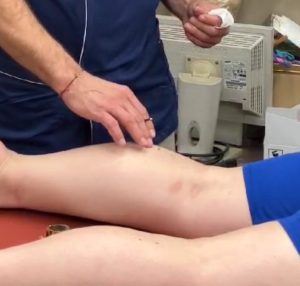 Developed by Isaburo Fukaya, this style is renowned for its clinical efficacy in treating complex conditions using “special points” rather than standard meridian locations. The hallmark of this style is the Bamboo Tube (Take Zutsu). The practitioner places the tube over a small moxa cone on the skin, allowing them to control oxygen flow and apply pressure to the surrounding area. This pressure “distracts” the nerve endings, making direct moxa feel comfortable rather than hot, and allowing the heat to penetrate deeply.
Postural Balance (Kinseikyu)
- Course: Introduction to Posture Balance with Moxibustion (Kinseikyu)
Teacher: Felip Caudet
Dates: 29–31 May 2026
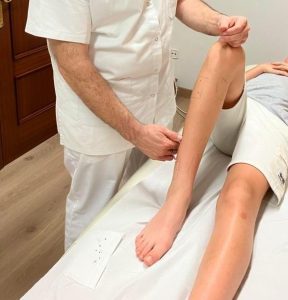 This approach posits that structural misalignment directly hinders the flow of Qi. Rather than “forcing” bones into place, Kinseikyu uses precise moxibustion to release tension in the body’s kinetic chains. By treating specific points that unlock muscular tension, the body is allowed to naturally realign itself. This is a unique, novel approach rarely taught in the UK, providing a powerful bridge between energetic and structural medicine.
2. Manaka Style: Yin-Yang Balancing
- Course: Manaka Acupuncture
Teacher: Marek Urbanowicz
Dates: 5–6 September & 26–27 September 2026
Dr. Yoshio Manaka (1911–1989) was a medical doctor, scholar, and artist who sought to bridge the gap between Western physiology and Eastern energetic concepts. His style is one of the most structured and coherent systems available to the modern practitioner.
Based on his scientific experiments, Manaka developed a four-step protocol:
Diagnosis: Heavily reliant on abdominal palpation to identify “Reflex Areas.”
Root Treatment: Using his famous Ion Pumping Cords (IPCs)—copper and zinc wires that create a microcurrent loop to balance ions without manual stimulation.
Structural/Branch Treatment: Addressing the physical structure, often via the Extraordinary Vessels.
Symptom Control: Direct treatment of the patient’s immediate complaint.
Teaching this approach is Marek Urbanowicz, who has utilised this system for over 20 years and had the privilege of learning the style from Dr. Manaka himself.
3. Structural Integration: Sotai (Sotai-ho 操体法)
- Course: Sotai
Teacher: Marek Urbanowicz
Dates: 18–19 July 2026
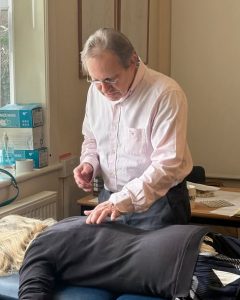
To truly round out a Japanese clinical approach, one must address the physical structure. Developed by Dr. Keizo Hashimoto, Sotai is a form of movement therapy that acts as the “antithesis” of Western physiotherapy.
“Moving Towards Comfort” The central tenet of Sotai is simple but profound: move away from pain. If a patient feels pain when turning their head left, Sotai directs them to turn their head right (the comfortable direction) against gentle resistance, followed by a sudden, total relaxation. This synchronized movement and breathwork resets muscle spindle tension via Reciprocal Inhibition. By engaging the agonist muscle in its comfortable range, the tight antagonist muscle is neurologically forced to relax.
For an acupuncturist, Sotai is an invaluable tool. It allows you to correct pelvic rotations or spinal twists that may be blocking your acupuncture’s effectiveness, transforming a passive treatment into an active partnership with the patient.
Why Refine Your Practice?
Embracing Japanese acupuncture is not about discarding your TCM training; it is about refining it. It is about learning to “listen” to the body with your hands and understanding that the lightest touch often creates the deepest change. By focusing on what the patient’s body is communicating in the moment—rather than relying solely on theory—we can achieve truly transformative results.
For more information or to book your place on these courses, please visit our CPD Page.
We hope to see you soon.